


Welcome to our latest Market Memo for October 2025. In this update, we'll cover the recent market "melt-up," the effects of the ongoing government shutdown,Federal Reserve rate cuts,inflation trends, and practical strategies to manage high valuations and potential risks in your investment portfolio.
The Market Melt-Up: A Strong Rally Continues
Since hitting lows in April, U.S. stocks have experienced an impressive melt-up, surging over 30% across major indices. This rally has been driven by a combination of positive economic data, corporate earnings resilience, and the expectations of more accommodative monetary policy. In October alone, equities returned approximately 2%, adding to the year's robust gains.
Notably, international markets have outperformed U.S. counterparts year-to-date, with emerging market indices leading the way. This divergence highlights potential opportunities beyond domestic stocks, especially as global growth stabilizes in regions like Europe and Asia. Source: Morningstar Direct as of 10/31/2025
Impacts of the Government Shutdown
The ongoing U.S. government shutdown has introduced uncertainty into the markets, affecting sectors reliant on federal funding and contracts. While the direct economic impact has been limited so far—thanks to private sector strength—prolonged disruptions could weigh on consumer confidence and business investment.
Despite these headwinds, markets have largely shrugged off the shutdown, focusing instead on broader economic indicators. However, investors should monitor developments closely, as a resolution could influence sentiment, while escalation might prompt shifts in market behavior.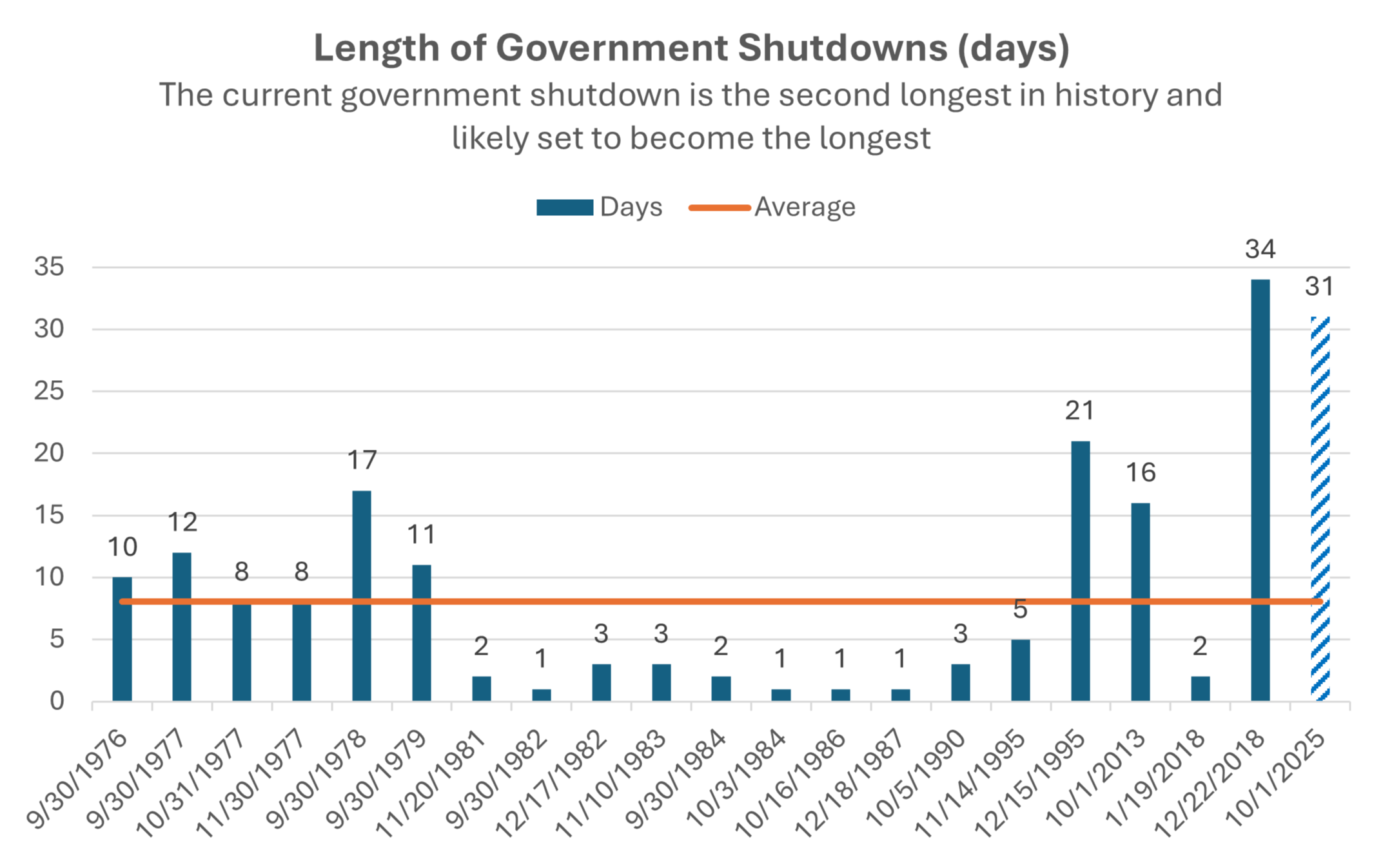
Source: USA Facts
Federal Reserve Actions and Rate Cuts
The Federal Reserve has continued its easing cycle with recent rate cuts, aiming to support a jobs market that is cooling, amid mixed signals. The Fed's policy stance is shifting toward neutral, balancing the need to address inflation with maintaining full employment. Unemployment remains stable at low levels, providing a buffer against recessionary pressures.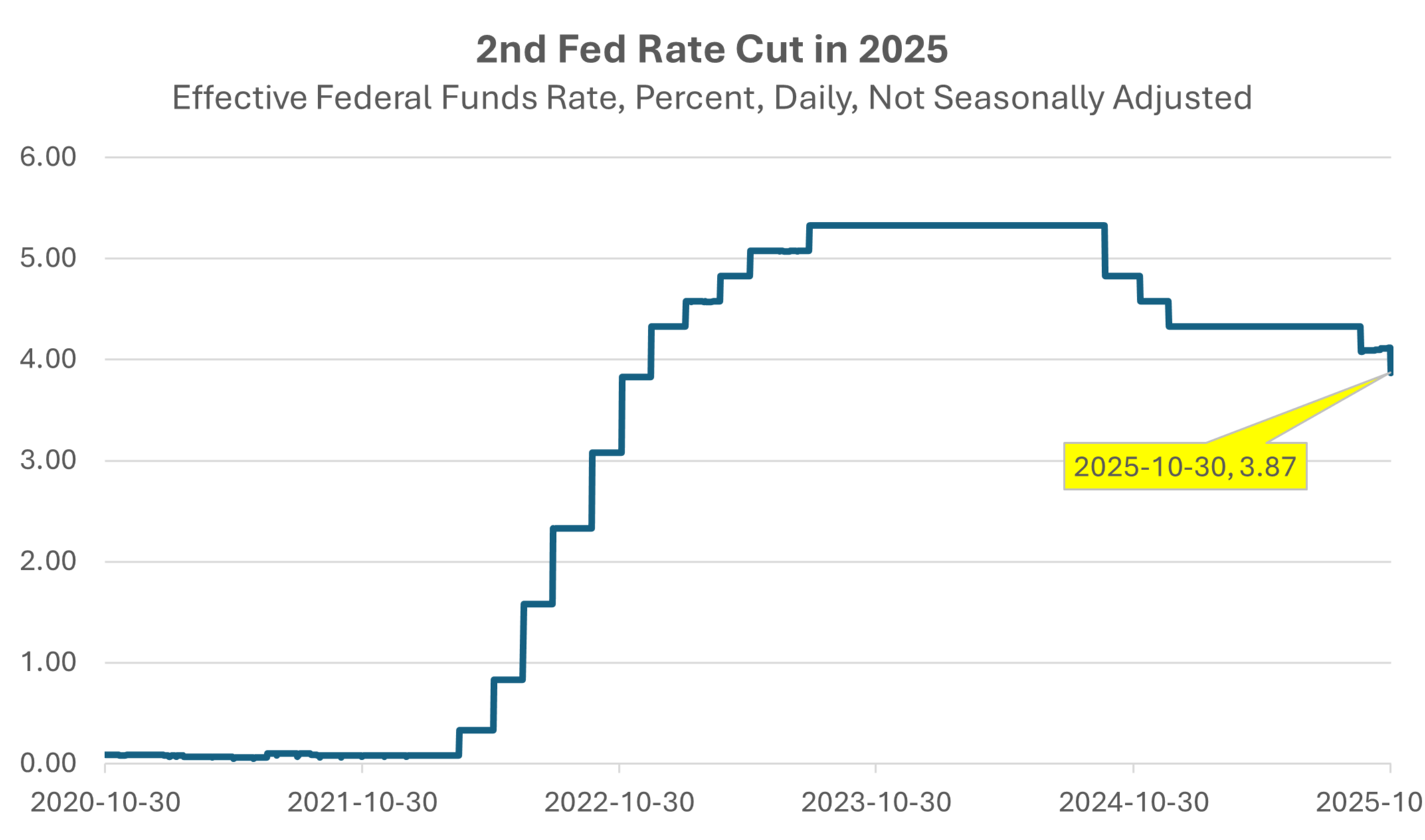
Source: Federal Reserve Economic Data
Fed chair, Jerome Powell, poured some cold water on the market expectations for another rate cut in December of this year, saying that there are growing disagreements on the future path of monetary policy within the committee and that more cuts are ‘far from’ certain. Odds of a rate cut fell on this news but remains our base case.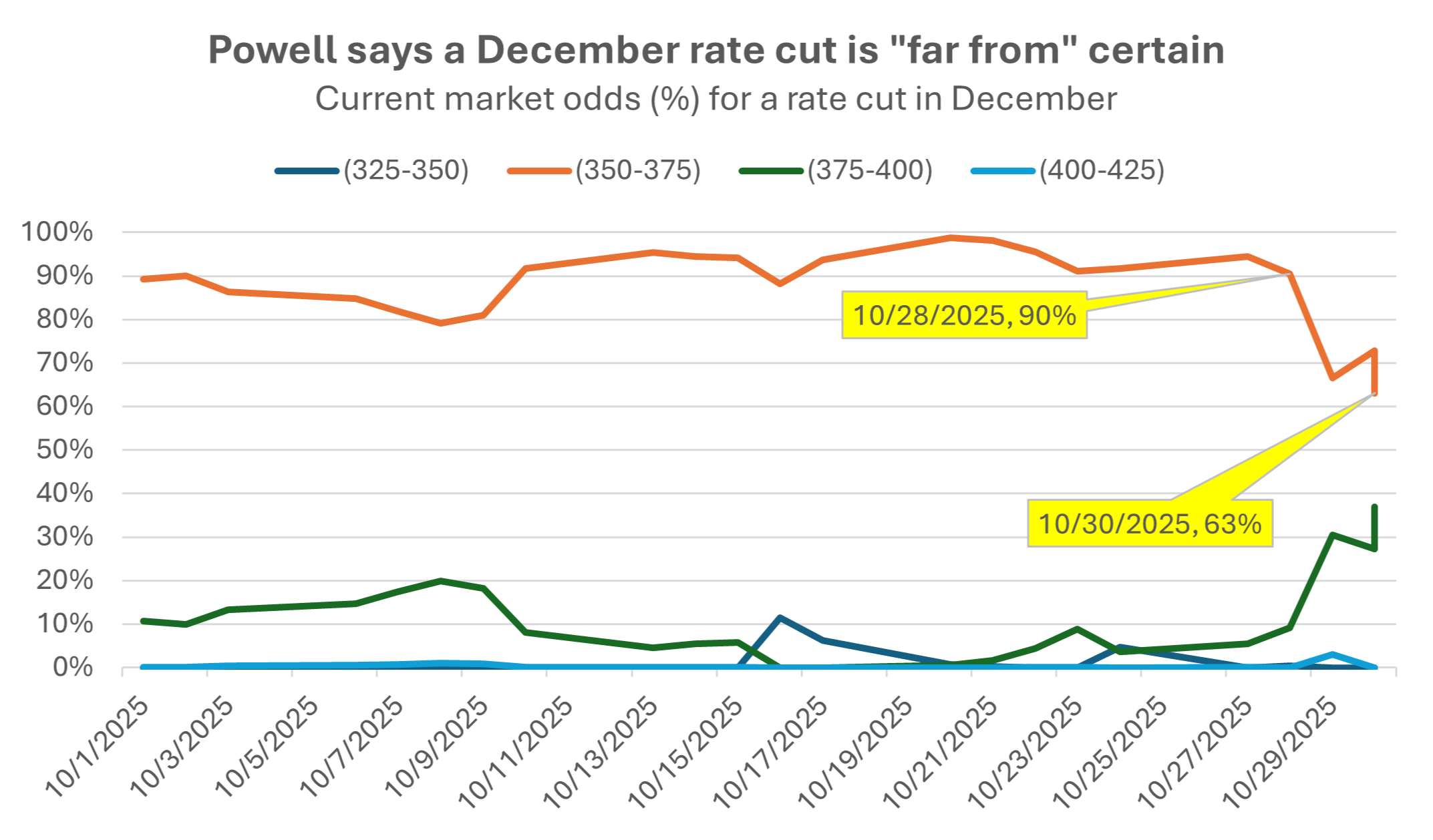
Source: CME Group
Inflation progress has stalled somewhat, with core measures hovering well above the 2% target but showing signs of moderation. The Fed's data-dependent approach is hampered here with the government shutdown, and they are admittedly ‘flying blind’ and may slow down similar to driving in a fog. Unemployment has been rising but is still within their expectation for the long-run at 4.3%.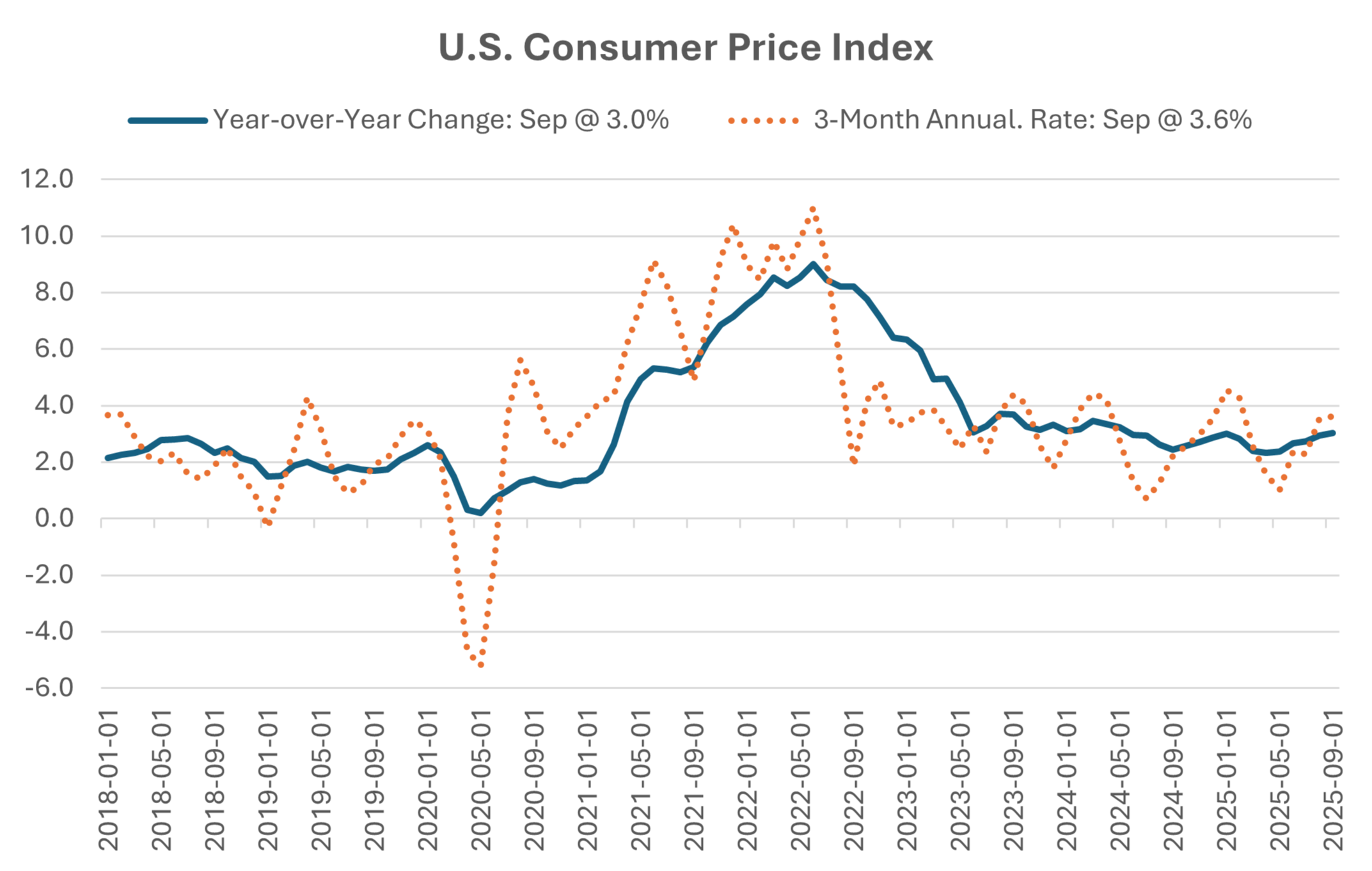
Source: Federal Reserve Economic Data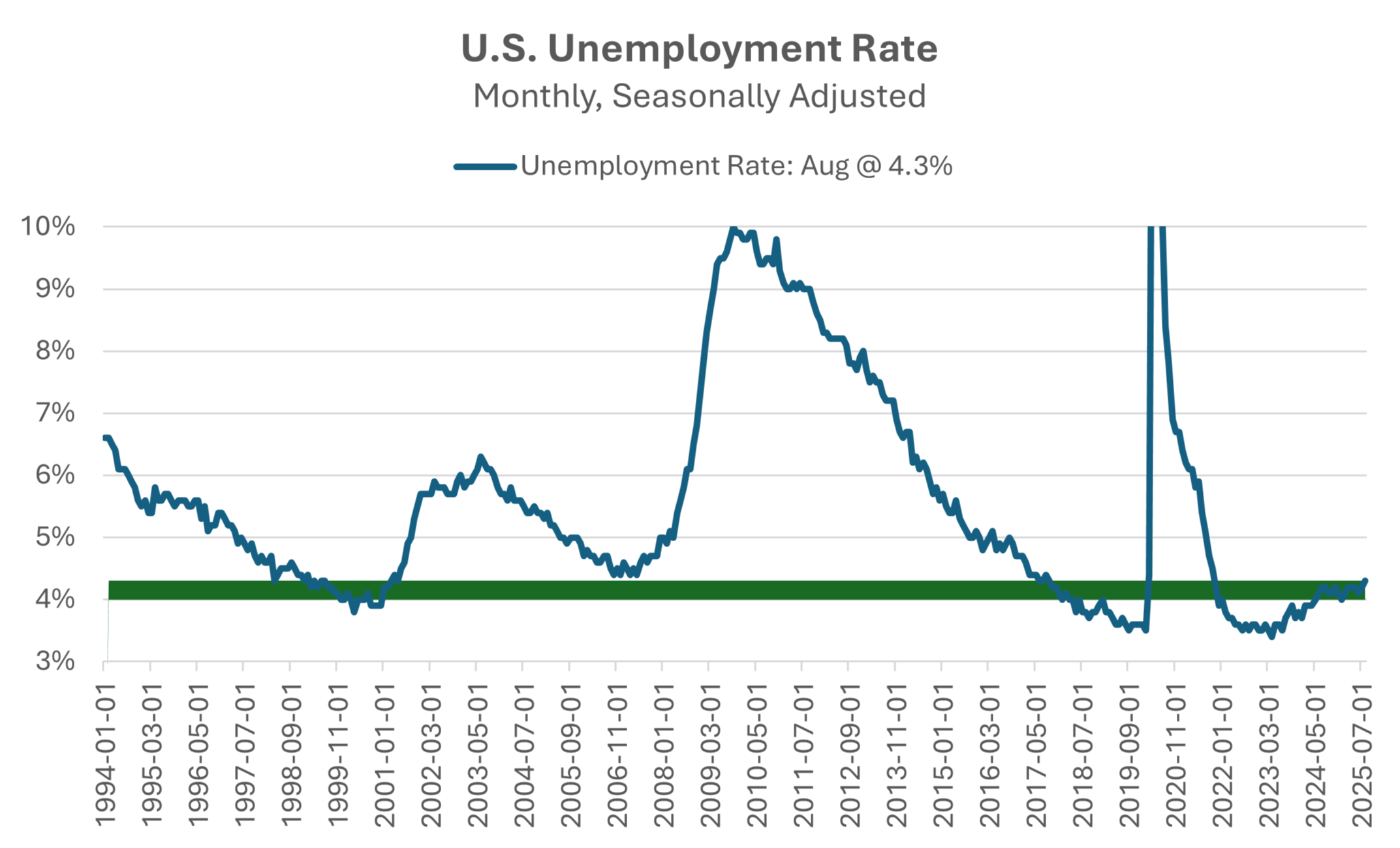
Source: Federal Reserve Economic Data
Real Fed Funds Rate is Nearing Neutral
If the Fed does cut one more quarter point in December (our base case) then the committee should feel more confident they are in the neutral zone based on historical averages. Currently the real Fed funds rate is about 0.49% above average and one more cut will get them closer to their seemingly consensus view of moving towards neutral away from restrictive. We expect a reassessment in 2026.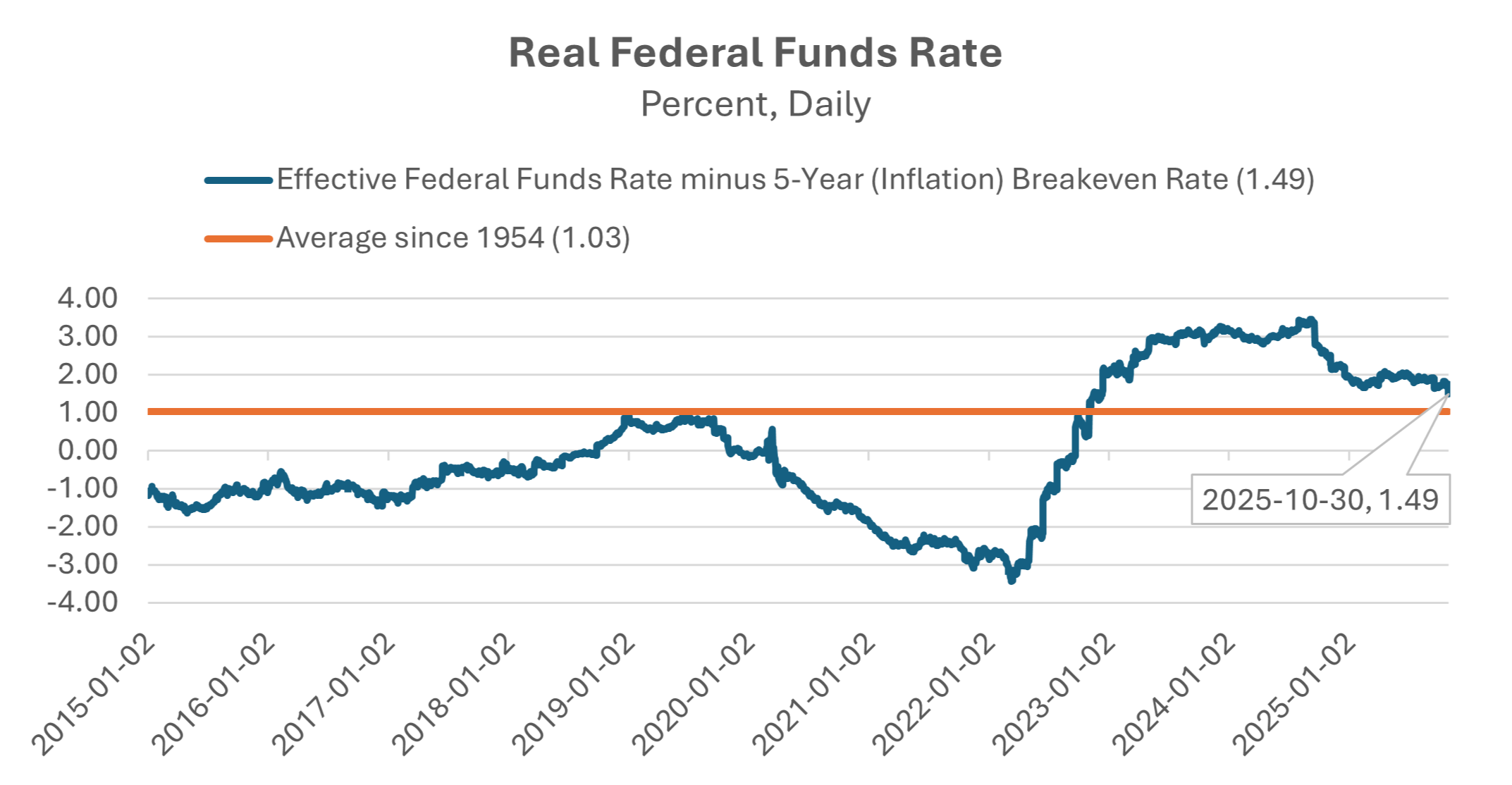
Source: Federal Reserve Economic Data
Navigating High Valuations and Risks
With markets at elevated valuations—price-to-earnings ratios stretching historical averages—investors face increased risks of corrections. Potential triggers include geopolitical tensions, unexpected inflation spikes, or a slowdown in corporate profits.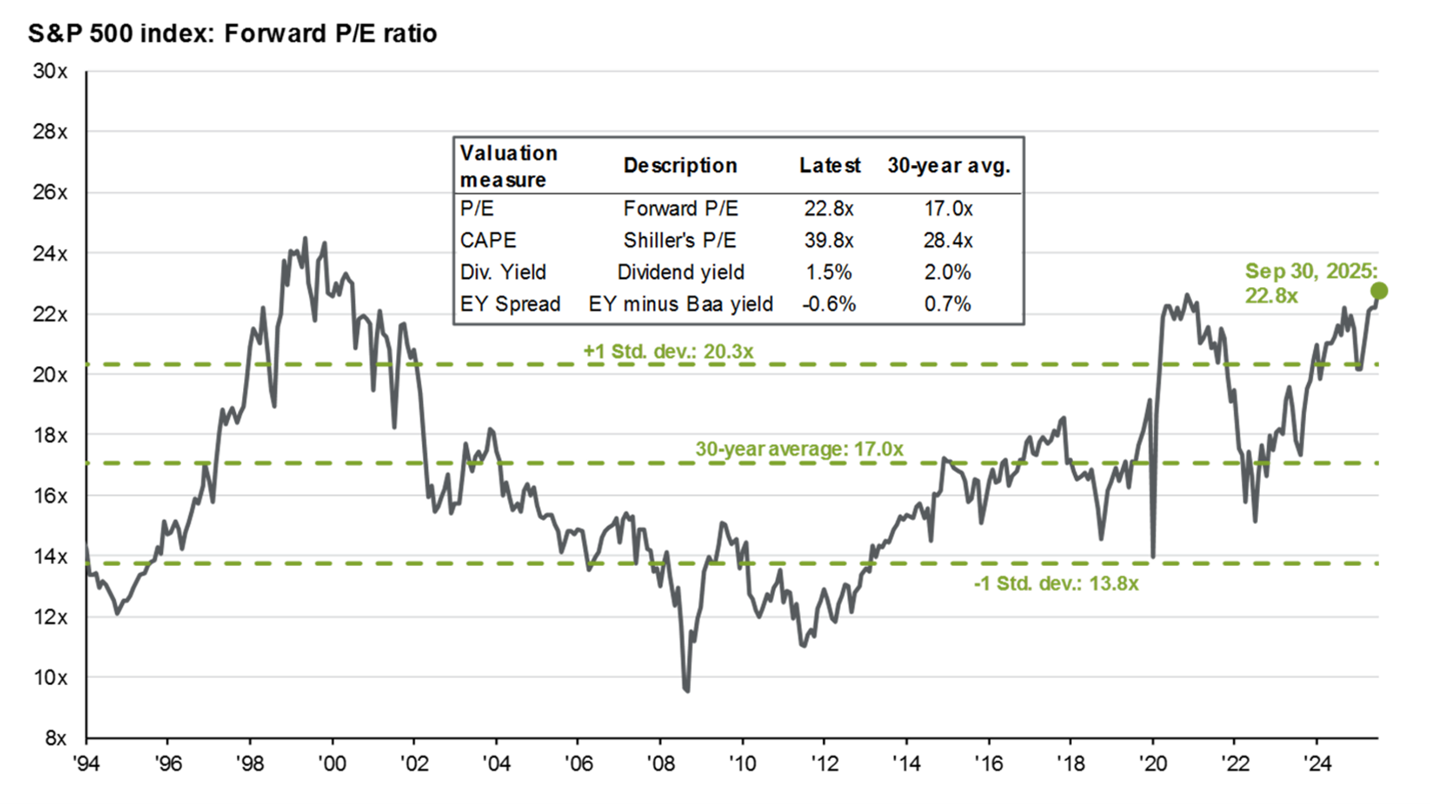
Source: JP Morgan
Now, to be sure, valuations alone are not a great ‘timing’ tool to tell you when to get in or out of equities in any market. As the one-year relationship is very weak, but going out further to 5 or even 10 years, then the relationship between starting valuations and future returns get more consistent.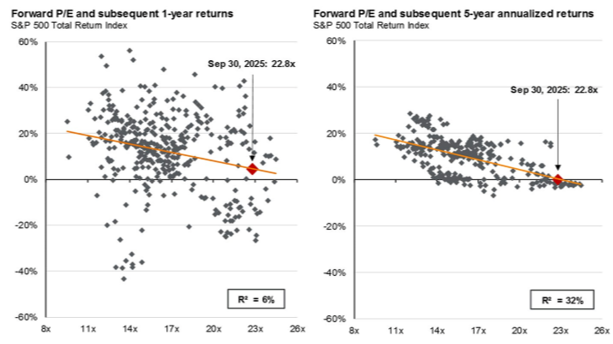
Source: JP Morgan
To address these risks, consider the following strategies:
- Diversification: Spread investments across other equities such as international equities, and small and mid-cap stocks. This may reduce exposure to U.S. stock concentration, as these areas are not a richly valued as U.S. Large Cap stocks. While diversification can help reduce market risk, it does not eliminate it. Diversification does not assure a profit or protect against loss in a declining market.
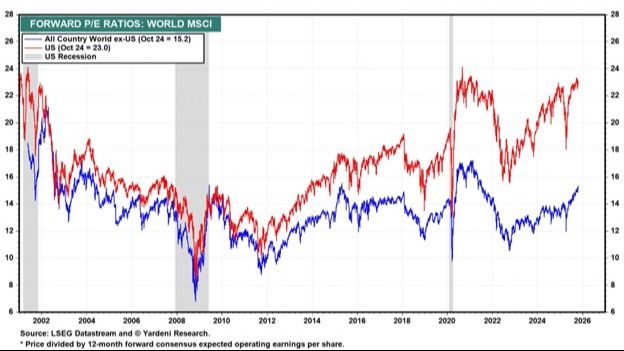
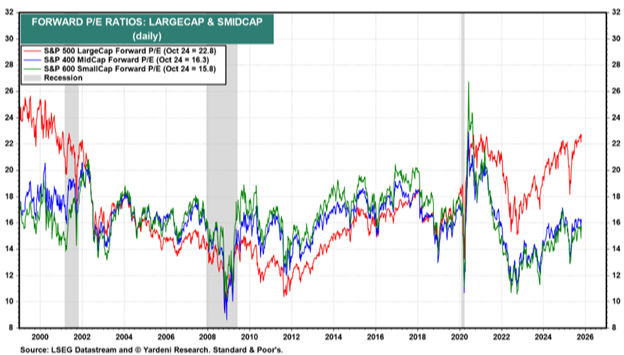
Source: Yardeni Research
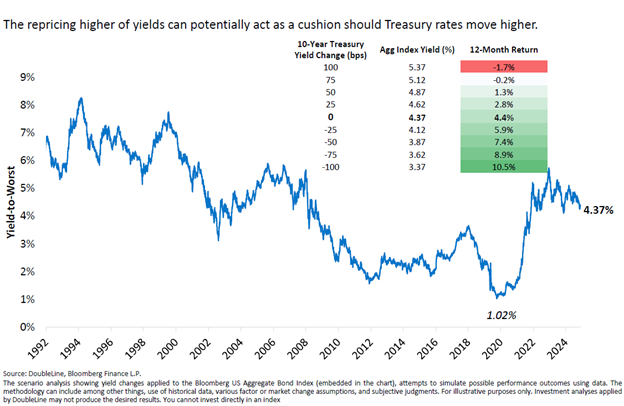
- Bonds and Cash: Over the last few years the yields of bonds (and cash) have moved higher and this leaves an opportunity for bonds to add diversification if rates fall due to economic weakness or a reduction in inflation or both. In fact, bonds in 2025 had delivered a much shallower drawdown, attractive yield and solid total return.
Source: DoubleLine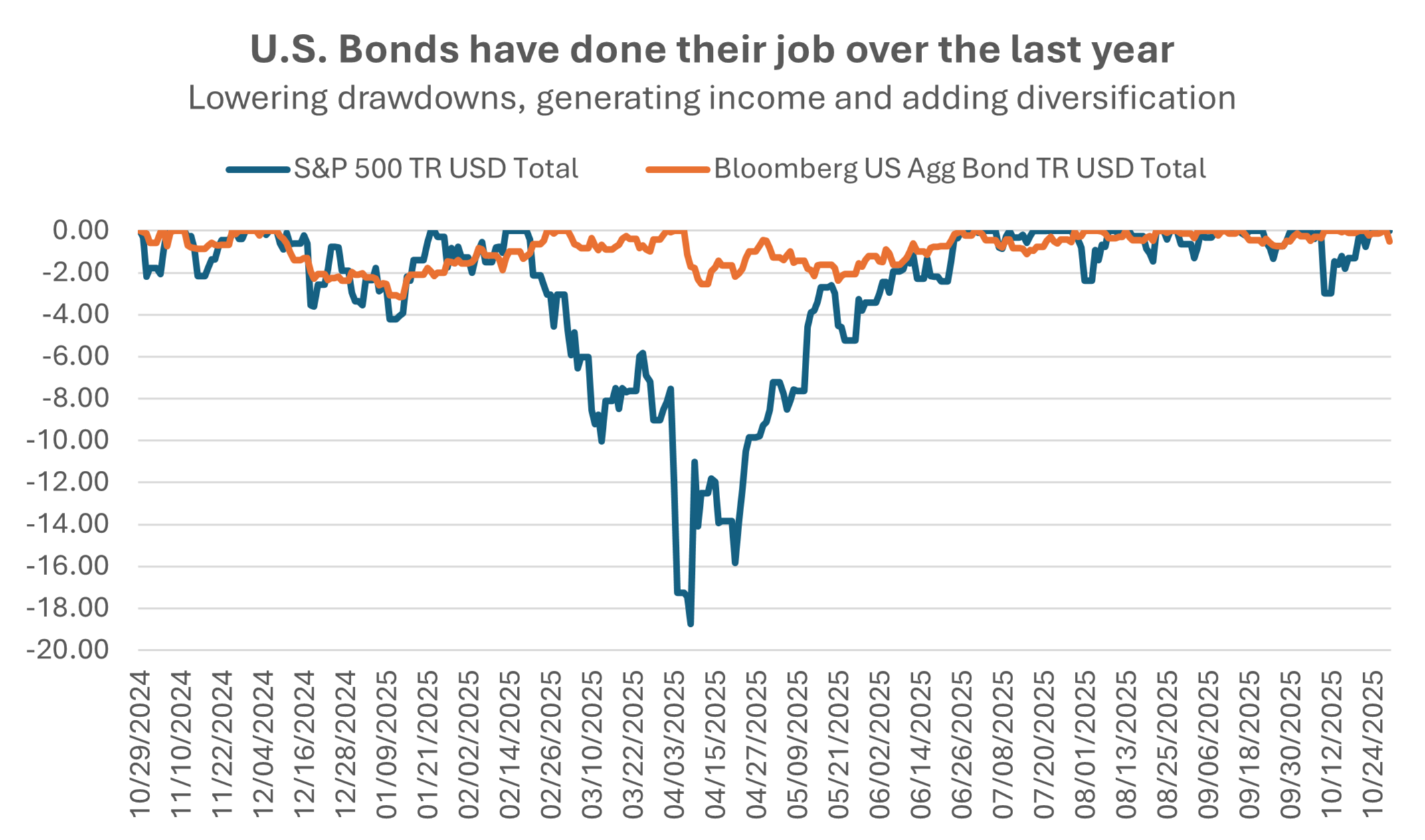
Source: Morningstar Direct, as of 10/29/2025
- Options Strategies: Use protective puts or collars to hedge against downside moves without fully exiting positions. These can serve as tools in volatile environments.
For retirement planning, consider long-term horizons and avoid knee-jerk reactions to short-term fluctuations. Focus on quality companies with strong balance sheets and consistent dividends.
Looking Ahead
As we head into the final months of 2025, the market's momentum remains intact, but caution is warranted. We will keep you informed on key data releases, such as employment reports and inflation figures, which could influence Fed decisions. Diversification and preparation for volatility are approaches to consider in managing a portfolio.
If you'd like more information on these topics, feel free to reach out. For the video version of this memo, check it out here.
References
1. How major US stock indexes fared Friday, 10/31/2025 - Yahoo Finance https://finance.yahoo.com/news/major-us-stock-indexes-fared-203201798.html (Details on end-of-October stock index performance.)
2. Monthly Market Update - October 2025 - Madison Investments https://madisoninvestments.com/resources/monthly_market_update_october_2025 (S&P 500 monthly and year-to-date returns.)
3. U.S. Equities Market Attributes October 2025 - S&P Dow Jones Indices https://www.spglobal.com/spdji/en/commentary/article/us-equities-market-attributes/ (Sector performance and index gains for October.)
4. Think the stock rally is over? It may just be beginning - CNN Business https://www.cnn.com/2025/10/27/investing/us-stock-market-rally (Discussion of the ongoing stock market rally since early 2025.)
5. Monthly Market Wrap: October 2025 - YCharts https://get.ycharts.com/resources/blog/monthly-market-wrap/ (Broad market gains and Nasdaq leadership.)
6. Why has the US government shut down and what does it mean? - BBC https://www.bbc.com/news/articles/crrj1znp0pyo (Overview of the shutdown's economic effects.)
7. 23 effects being felt on Day 35 of the shutdown - CNN Politics https://www.cnn.com/2025/11/04/politics/shutdown-impacts-snap-wic-parks-federal-worker-pay-analysis (Detailed impacts on federal programs and economy.)
8. Federal Government Shutdown: What It Means for States and Programs - NCSL https://www.ncsl.org/in-dc/federal-government-shutdown-what-it-means-for-states-and-programs (Effects on state budgets and programs starting October 1, 2025.)
9. With SNAP pause, US government shutdown could have bigger impact than initially expected - RBC https://www.rbc.com/en/thought-leadership/economics/featured-insights/oh-snap-u-s-government-shutdown-could-have-bigger-impact-than-initially-expected/ (Analysis of consumer spending pullback.)
10. US Government Shutdown: What's the Impact? - J.P. Morgan https://www.jpmorgan.com/insights/global-research/current-events/government-shutdown (Implications for labor market and asset classes.)
11. Federal Reserve issues FOMC statement - Federal Reserve https://www.federalreserve.gov/newsevents/pressreleases/monetary20251029a.htm (Official October 29, 2025, rate cut announcement.)
12. Fed cuts rates again, but Powell raises doubts about easing - CNBC https://www.cnbc.com/2025/10/29/fed-rate-decision-october-2025.html (Details on the quarter-point cut to 3.75%-4%.)
13. Federal Reserve cuts interest rates 0.25% - U.S. Bank https://www.usbank.com/investing/financial-perspectives/market-news/federal-reserve-interest-rate.html (Summary of the rate adjustment.)
14. What the Fed Rate Cuts Mean for Housing and the Economy - NAHB https://www.nahb.org/blog/2025/09/fed-cuts-rates (Projections for GDP, unemployment, and inflation in 2025.)
15. United States Inflation Rate - Trading Economics https://tradingeconomics.com/united-states/inflation-cpi (Annual inflation at 3% in September 2025.)
16. Consumer Price Index Summary - 2025 M09 Results - BLS https://www.bls.gov/news.release/cpi.nr0.htm (CPI details for September 2025.)
17. Current US Inflation Rates: 2000-2025 - US Inflation Calculator https://www.usinflationcalculator.com/inflation/current-inflation-rates/ (Year-over-year inflation at 3% ending September.)
18. Inflation Nowcasting - Federal Reserve Bank of Cleveland https://www.clevelandfed.org/indicators-and-data/inflation-nowcasting (October 2025 inflation estimates around 2.96-2.99%.)
19. CPI inflation September 2025: Inflation rate hit 3%, lower than expected - CNBC https://www.cnbc.com/2025/10/24/cpi-inflation-september-2025.html (Monthly increase and annual rate details.)
Index Benchmarks presented within this report may not reflect factors relevant for your portfolio or your unique risks, goals or investment objectives. Past performance of an index is not an indication or guarantee of future results. It is not possible to invest directly in an index.
The Consumer Price Index (CPI) is a measure of the average change over time in the prices paid by urban consumers for a market basket of consumer goods and services.
The S&P 500® Index, or the Standard & Poor's 500® Index, is a market-capitalization-weighted index of the 500 largest U.S. publicly traded companies.
The price-to-earnings ratio (P/E ratio) is the ratio for valuing a company that measures its current share price relative to its earnings per share (EPS). The price-to-earnings ratio is also sometimes known as the price multiple or the earnings multiple.